LOAR NEWS
Aug 5, 2026: LOAR group paper published in Journal of Chromatography A establishing UHPLC–Orbitrap-MS protocols to detection RNA building blocks and short RNA oligomers.
New study led by Mia Trodden, co-developed with Mariana Aguilar and Ishaan Madan, uses a zwitterionic HILIC column from Waters for the robust, sensitive, and accurate detection of RNA building blocks as well as RNA dimers, trimers and tetramers. This study forms the foundation of RNA building block analysis in our lab and paves the way for analyzing complex samples such as Miller–Urey prebiotic soups, and organic haze particles.
Read the open-access paper here.

July 30, 2026: Rinat Ilyussizov presents research on ammonia-free alanine production on Titan at SURF undergraduate conference

Rinat Ilyussizov

May 5, 2026: Gretchen Minich wins Spring Undergrad Conference Award
March 3, 2026: Ben Pearce granted Best Reviewer Award by Icarus Journal. See news article here.
Dec 9, 2025: New Paper Published in Planetary Science Journal on Prebiotic Chemistry Insights for Dragonfly
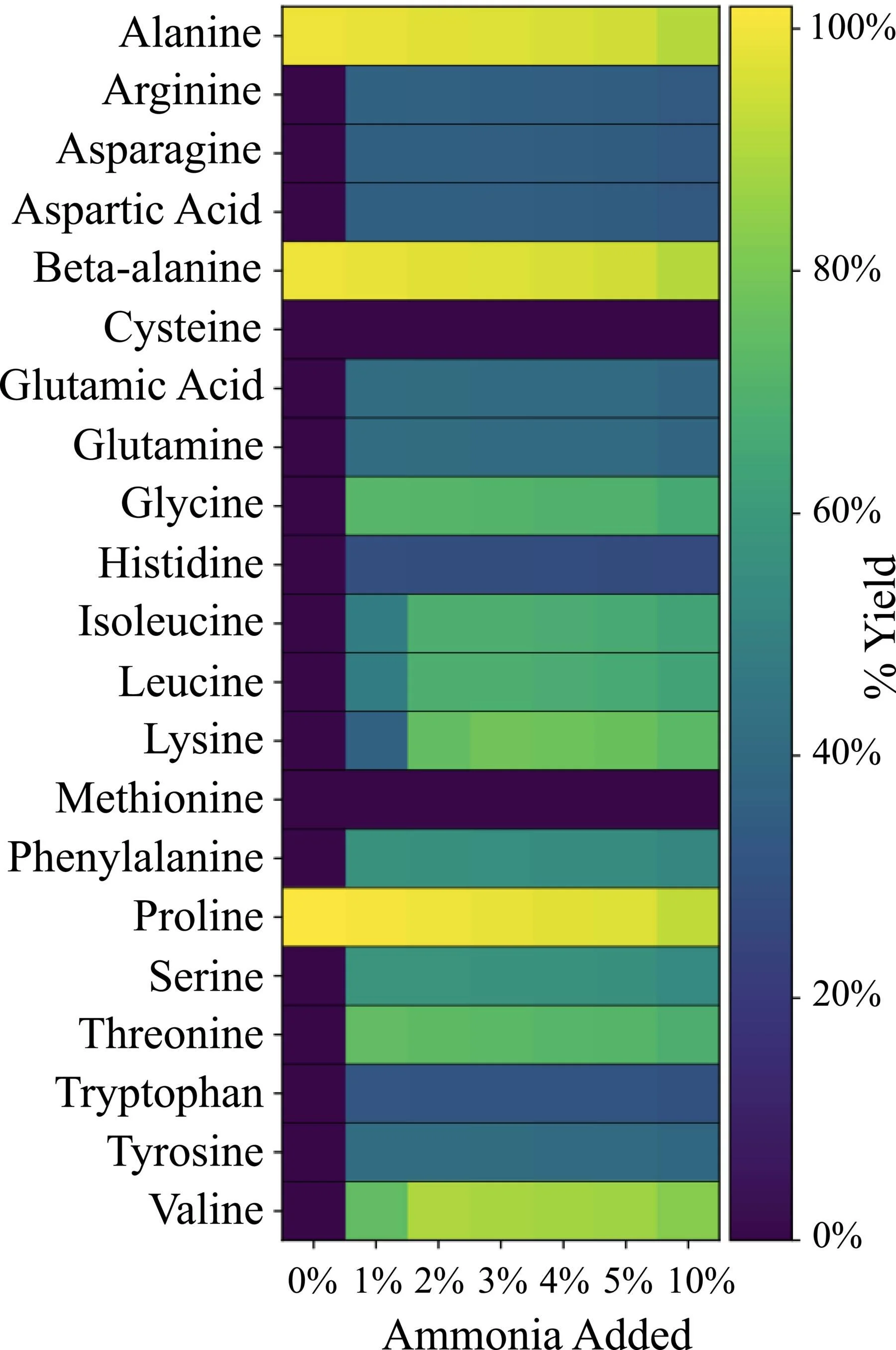
Ishaan’s models on the thermodynamics of amino acid synthesis in Selk crater on Titan show that 21 different amino acids are favorable to be produced in these post-impact ponds; however, only 3 amino acids are favorable in the absence of NH3: proline, alanine, and β-alanine. The NH3-free alanine result implies alternative pathways beyond classical Strecker or aminonitrile hydrolysis, suggesting acetylene (C2H2), abundant on Titan but scarce on early Earth, as a plausible feedstock. These predictions are directly testable with the Dragonfly Mass Spectrometer, for which we recommend preflight standards to test proline, alanine, β-alanine, cysteine, and methionine. The first three offer the best chances for amino acid detection regardless of ammonia availability; the latter two offer diagnostic tools for determining the presence of reactive sulfur in postimpact Titan ponds.
See the News Article and Madan & Pearce (2025) for more information.
Aug 25, 2025: Ishaan Madan awarded NSF GRFP
“Winning the NSF GRFP is both an immense honor and a personal milestone. This award feels like a moment of recognition of my academic potential and also of the hard work, resilience and community that have shaped my journey,” says Madan, who received an undergraduate degree in biochemistry from Wheaton College in Massachusetts. “The NSF GRFP gives me the freedom to fully focus on my research and academic growth throughout my PhD.”
See the News Article for more information.
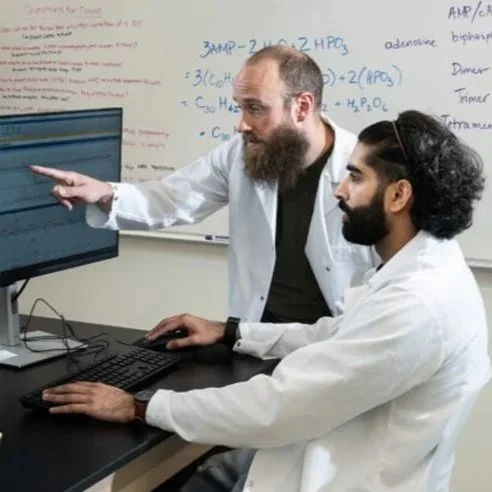
Prof. Ben Pearce and PhD Candidate Ishaan Madan, Aug 25, 2025